


















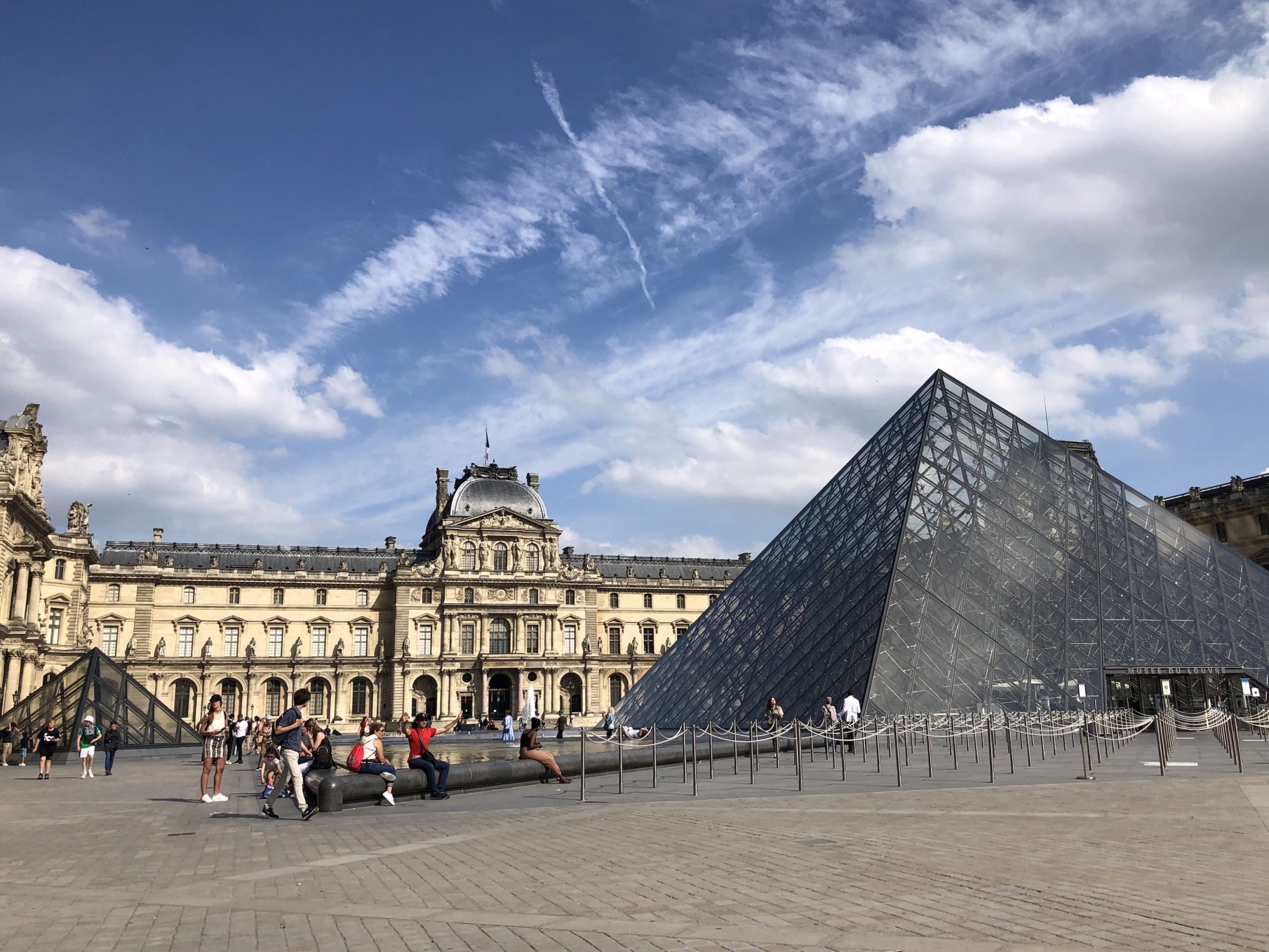
The recent Louvre heist has saturated every aspect of the media. On one end, sensationalized news stories sharing details about the suspects’ personal lives run amuck. Thanks to MetroUK, we now know at least one of them is a dirtbike stunt legend. Meanwhile, teenagers on TikTok are writing borderline romance novellas about the thieves that likely aren’t astoundingly handsome 20-year-olds. A tale as old as time wrapped up in a neat bow that is the cybersecurity lesson it taught us all: change your passwords. Seriously. Using “Louvre” as your surveillance system password when you are the Louvre, is not as secure as you hope it is. Clad in neon construction vests, the robbers were in and out in under eight minutes in a professional-style operation aided by a truck mounted ladder to get them on the balcony to the Apollo Gallery.
Clad in neon construction vests, the robbers were in and out in under eight minutes in a professional-style operation aided by a truck mounted ladder to get them on the balcony to the Apollo Gallery. But in between these tragically telling instances of twenty-first century zeitgeist, we seem to have lost sight of both the literal and metaphorical crown jewels of the Louvre’s collection.
But in between these tragically telling instances of twenty-first century zeitgeist, we seem to have lost sight of both the literal and metaphorical crown jewels of the Louvre’s collection.
Well-known for housing “the Mona Lisa,” the Louvre was originally a twelfth century palace where the French monarchs spent their days. Since the mid-eighteenth century, it has functioned as an art gallery that now holds the distinction of being one of the most well known museums in the world. In the recent heist, nine jewelry items were taken from the Apollo Gallery, the section of the Louvre which houses many of France’s crown jewels- the belongings of the very nobility that once resided in the palace. Empress Eugenie de Montijo seems to have taken the greatest hit to her legacy, as three of the stolen pieces once belonged to her. These include her tiara, encrusted with thousands of diamonds and over two hundred pearls, a decorative bow possibly used as the centerpiece of a belt and a diamond brooch. In a lucky twist of fate for Montijo, her crown was recovered, though badly damaged. “It appears that repairing it will be delicate but possible,” states Laurence des Cars, president and director of the Louvre. The other missing items are a sapphire set consisting of a tiara, necklace and one earring from a pair. Also taken were emerald earrings and a matching necklace given by Napoleon to his second wife as a wedding gift.
So, now that we’ve covered what was taken,, what exactly does the Louvre have left? The answer: A lot. The museum owns over 600,000 items from around the world, with ancient civilizations such as Greece, Rome and Egypt particularly pervasive in the collection. Acquisition of many of these pieces has been controversial at best, with Egypt calling for the return of “the Dendera Zodiac,” which the Louvre has declined. Conversely, frescoes excavated and stolen from a tomb, however, have been given back to Egypt by the museum. While “the Mona Lisa” is the most famous artwork displayed at the Louvre, other prominent marks of the museum include “the Winged Victory of Samothrace” at the entrance, and the famed “Venus de Milo” further inside.
The recent robbery at the Louvre, while certainly scuffing its reputation in the modern era, is only a mark in a long history of rich cultural artifacts and artwork of global importance.
The recent robbery at the Louvre, while certainly scuffing its reputation in the modern era, is only a mark in a long history of rich cultural artifacts and artwork of global importance. While audiences can only hope for the safe return of the stolen jewelry to return for the public to enjoy, there is still a vast collection of hundreds of thousands of works to explore. All we can hope for is for this heist to teach the Louvre a valuable lesson before anybody remembers the successful theft of the Mona Lisa in 1911 and tries to run it back over a century later– just because somebody is wearing a neon vest does not mean they actually are a construction worker.

