



















When the newly revived Muhlenberg College Republican Organization first considered tabling in Seegers Union, club leaders told The Weekly that they had planned to “engage in open political discourse” while encouraging “students to interact with different viewpoints in a manner that is mutually respectful and constructive.” Or at least, that’s what they had hoped for.
Instead, their event sparked significant controversy, leading to heated campus discussions about political discourse, inclusivity and the role of student organizations in shaping public debate. At the core of this uproar: the decision by the College Republicans to table with representatives from Turning Point USA (TPUSA).
Founded by the conservative political activist and media personality Charles “Charlie” Kirk in 2012, TPUSA is a nonprofit organization that advocates for conservative politics on high school, college and university campuses. Often described as the fastest-growing organization of campus chapters in America and the dominant force in campus conservatism, TPUSA gained national attention for its efforts to “expose professors who discriminate against conservative students and advance leftist propaganda in the classroom” through a “Professor Watchlist,” which even included Maura Finkelstein, whose employment status at Muhlenberg is still unknown. TPUSA has since faced criticism for what the College Democrats’ statement claimed was “a well-documented history of promoting inflammatory rhetoric, attacking diversity and inclusion initiatives, and targeting marginalized communities.”
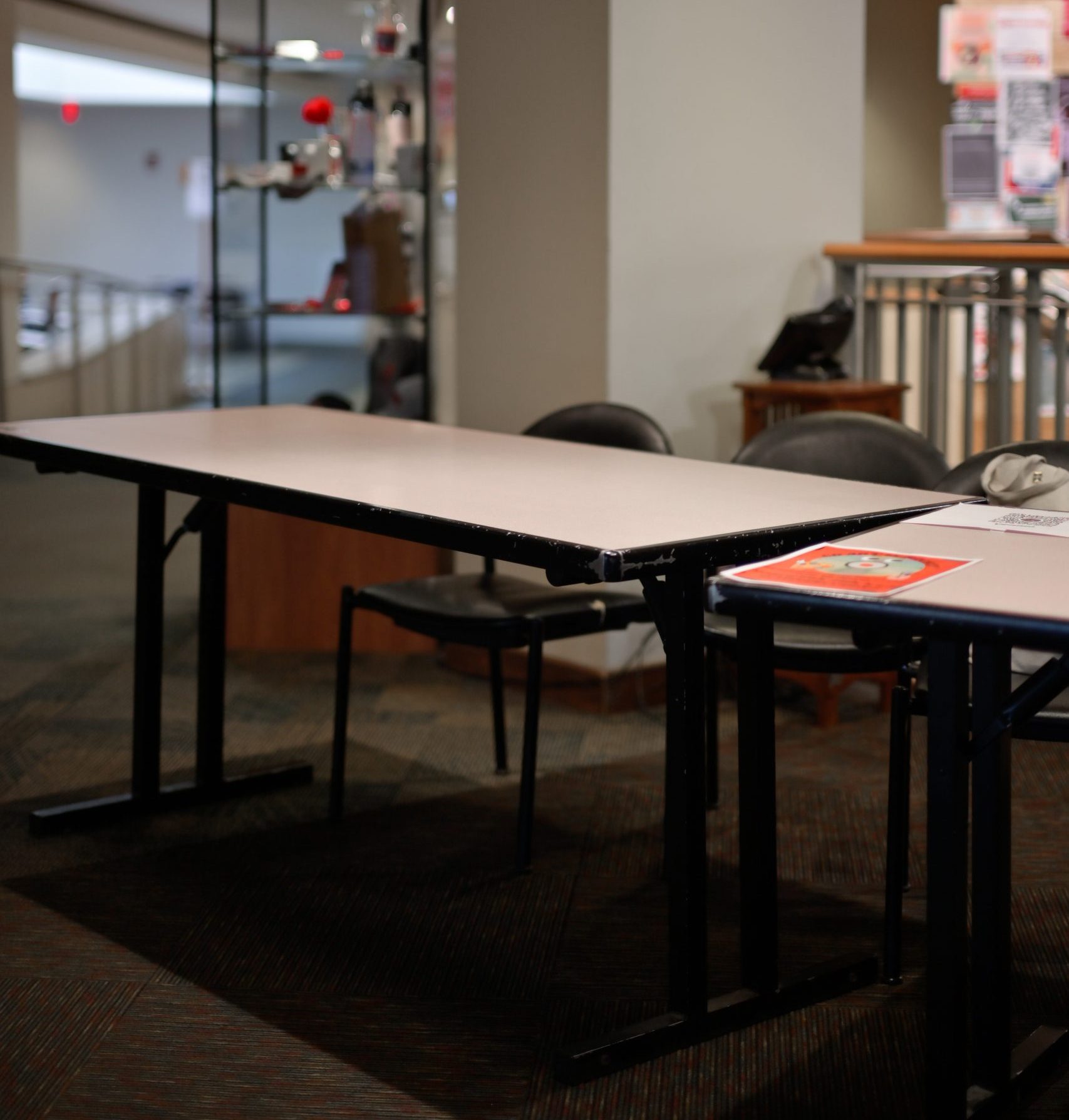
It was this history that raised concerns among many students regarding the College Republicans’ decision to collaborate with them for their event on March 6. That Thursday, the group hosted a table by the entrance of Seegers Union, where TPUSA materials were distributed. Some of the displayed signage and messaging – particularly those critiquing DEI initiatives with phrases like “DEI – Didn’t Earn It” – quickly became a flashpoint for criticism. Students across campus, including members of advocacy groups like Students for Queer Advocacy (SQuAd) and the Muhlenberg Trans Advocacy Coalition (MTAC), condemned TPUSA’s presence, arguing that the group promotes exclusionary and harmful rhetoric.
In an official statement posted on social media, SQuAd and MTAC wrote:
“Today a student group will be tabling with a representative of Turning Point USA. This external organization promotes hateful beliefs about communities on Muhlenberg’s campus that should have a safe place here. Muhlenberg Students for Queer Advocacy and Muhlenberg Trans Advocacy Coalition condemn this action. No representative from this organization should be on campus. Stay informed, stay safe, stay proud.”
Responding to questions from The Weekly, SQuAd leaders expressed fears that the event contributed to an unsafe atmosphere for LGBTQ+ students, citing TPUSA’s history of anti-trans rhetoric and opposition to diversity, equity and inclusion (DEI) initiatives. “We were specifically concerned about Turning Point’s ideologies of extreme anti-trans hate and opposition to DEI practices that help LGBTQ+ students feel safe in environments that would not be safe for us otherwise,” the group stated. They also highlighted that the event’s location in a central campus space made it difficult for students to avoid an interaction that many found distressing.
The backlash was not limited to student groups. Many current students and alumni took to social media to share their discomfort, frustration and concerns about the impact of TPUSA’s presence on campus. Among them was Kathy Christie ’27, who was particularly vocal about how the messaging personally affected her. As a student of color, seeing those signs felt like “a slap in the face” and an attack on “[her] identity” and the hard work she had put into everything she had achieved. “And when one of their members said, ‘We don’t believe in equity or equality,’ it just left me dumbfounded.”
Among the voices critical of the event was alum Ally Duvak ‘22, who expressed deep disappointment in the College’s handling of the situation. “I wish I had been more surprised,” she said, referencing what she sees as a growing conservative presence on campus since the removal of anthropology professor Maura Finkelstein over her pro-Palestinian views. Duvak, who identifies as “a member of the queer community,” described feeling “completely disconnected” from her alma mater, highlighting that a lack of action against organizations like TPUSA sends a troubling message to marginalized students. “There is a difference between free speech and hate speech,” she said. “Turning Point USA actively seeks to strip rights from queer and BIPOC people. The College’s failure to recognize that – or worse, its willingness to ignore it – is deeply concerning.” She also criticized the administration’s response, noting the irony of receiving a donation request from the Office of Annual Giving just days before the event. “I absolutely cannot donate to a school that continues to prioritize hateful rhetoric over the safety and well-being of its students,” she stated.
“We’re not against political discourse, we’re against platforms that actively harm our community.”
Following the outcry, the College Republicans took to their Instagram story and released a statement acknowledging the backlash and expressing regret over aspects of the event.
“Our club shares relative, general beliefs that align with the foundational principles of organizations like TPUSA, but we did not fully vet their messaging before inviting them to campus,” the statement read. They added, “when a large-scale, reputable organization reached out to us, we (as a brand new, small college republicans club) were excited at our first opportunity for exposure and support. We take full accountability for our lack of understanding as to what these organizations would bring to our campus.” Going forward, their statement committed the Club to being “more diligent in researching potential partnerships,” and a commitment to not “working with these organizations in the future.”
That story has since disappeared from their profile. When asked why they decided not to include the statement on a permanent post, they explained that “a trusted individual who would like to remain anonymous advised us to leave it as a story post for 24 hours and not make it a highlight. We took his advice on that and just left it as a story post.” They explained that they didn’t want the statement on their newly established Instagram page to define them as they were “trying to build [their] reputation.” In a series of follow-up questions, members of the College Republicans further elaborated, stating that their intent was to provide a space for conservative students to engage in political discussion, not to alienate or offend.
“We recognize that certain aspects of the event created an unwelcoming atmosphere,” the executive board said. “That was never our goal, and we will be taking steps to ensure our future events foster open yet respectful dialogue.” When asked about the decision to take the table down early, they explained that it was due to “growing backlash and concerns raised by students both in-person and online.” However, the group also highlighted that their members faced significant personal attacks in the aftermath of the event, including doxing and the leaking of personal medical information, adding that while they “fully accept criticism of the club’s actions, it’s disheartening to see students attacking individuals rather than engaging in constructive dialogue.” It is because of this significant backlash that The Weekly respected their request not to name individual members, opting to cite the group as a whole to protect their safety and privacy.
The Weekly also asked the College Republicans how their partnership with TPUSA came to be, and they clarified that their initial conversations with TPUSA were more focused on securing funding for future events and receiving guidance on how to build their organization. “Our TPUSA representative offered support for us and encouraged us to start a chapter with them as a great opportunity to expand our organization,” the board explained. They emphasized that they did not anticipate that TPUSA’s representative would bring his own signs or push a specific agenda, which led to unexpected controversy. “We had no idea that he was going to use his own signs and push what he wanted to say instead of letting us represent ourselves,” they added, noting that they envisioned the event as a space for open political discourse, not as a platform for one group’s rhetoric.
The College Republicans also expressed regret over how the event unfolded. “We felt taken over by TPUSA, and didn’t really have a say with what happened when the representative showed up,” the board shared. As a result, the group decided to take down one of TPUSA’s most contentious signs, which read “DEI – Didn’t Earn It.” They acknowledged that the sign was not their own, but they removed it after realizing it contradicted their club’s mission, reflecting that “having those signs up was going against our mission statement.” Herein, they highlighted that while individual members may share some of TPUSA’s beliefs, the club as a whole does not endorse divisive messaging. “We, as a club, will not be associating with signage that may be offensive in the future.”
In the aftermath of the event, the administration has also come under scrutiny, with students questioning whether proper oversight was exercised before allowing TPUSA to table on campus. In response, Vice President for College Life Kimberly Guyer and Dean of Students & Director of Student Conduct Courtney Stephens clarified that the College Republicans had followed appropriate event registration procedures and that the administration is committed to ongoing dialogue about political advocacy at Muhlenberg. When questioned further, they acknowledged the need for reevaluation, stating, “We are currently reviewing our policies and processes to determine what additional measures should be considered when an external group is invited to campus by a student organization.”
President Kathleen Harring also reaffirmed the College’s stance on free speech, stating:
“The College is deeply committed to freedom of expression and inquiry. Our mission aims to develop in students the skills necessary to engage in constructive dialogue across perspectives and viewpoints.”
However, some students and alumni have voiced frustration with what they perceive as a slow or inadequate response from the administration. In response, Guyer and Stephens emphasized that “the College’s primary responsibility is to provide support and resources to any student who is struggling or feels harmed.” They also noted that spring break timing made immediate follow-up more challenging, but efforts have since been made to address concerns, with College Life staff reaching out to “students who have shared feedback and are working with them to plan restorative-based conversations.”
On Tuesday, March 25, the Dean of Students Office sent a campus-wide email reaffirming Muhlenberg’s commitment to free speech while emphasizing the need for respectful dialogue, stating, “Intent does not always equal impact.” However, student leaders, particularly from SQuAd, found the statement inadequate, arguing it failed to acknowledge the specific harms caused by Turning Point USA’s presence. They criticized the email for lacking transparency regarding the approval process, calling it “a gentle reminder about their preexisting policies” rather than what they viewed as an administrative failure. They emphasized that “a more direct acknowledgment of the events that transpired is necessary,” as the email did not explicitly address the concerns of marginalized students or explain how the College would prevent similar situations in the future.
Further critiques highlighted the timing and vagueness of the response. Christie expressed frustration, stating, “This email was far too late and too vague to actually mean much or have a real impact.” SQuAd noted that while it’s likely that campus activism prompted the administration’s response, students and alumni “shouldn’t have had to push so hard for a response in the first place.” They argued that the email placed undue responsibility on students rather than addressing the administration’s role in approving TPUSA’s presence, stating, “Somebody approved this event, and now we’re the ones left dealing with the consequences.” Moving forward, they would like to see clearer policies on vetting external groups and a stronger institutional stance against organizations they view as counter to Muhlenberg’s stated values of inclusivity and respect.
The controversy surrounding this event has reignited larger discussions about the balance between free speech and inclusivity on campus. Many students have called for more transparent policies regarding external organizations’ tabling at Muhlenberg, while others argue that student groups should be held more accountable for vetting the partners they choose to engage with. SQuAd, for its part, has reiterated its commitment to advocating for the safety and well-being of marginalized students. “We’re not against political discourse,” they stated. “We’re against platforms that actively harm our community.”
The College Republicans, meanwhile, insist they remain committed to fostering respectful dialogue and have expressed interest in collaborating with groups of differing perspectives to encourage constructive conversations. “We are currently working on a newsletter with three other political groups on campus,” they shared. “We believe meaningful dialogue comes from engaging with diverse perspectives.”
As Muhlenberg continues to grapple with these tensions, the administration, student organizations and individual students alike will need to consider how to create a campus environment that upholds both the principles of free expression and the imperative of fostering a community where all students feel safe and valued. Towards the end of our interview, Christie added that on the day of the tabling event, her friend had cautioned her to stay away from Seegers. “If I need to be warned about your event, that probably means it’s not a good thing.”

Kabir Burman '27 is an international student from India double majoring in media & communication and political science. He is constantly looking for new ways to bring you the stories that matter and feature different perspectives. If you can't find him in the newsroom, you'll find him playing the piano, taking a nap, or planning his next trip to NYC!