



















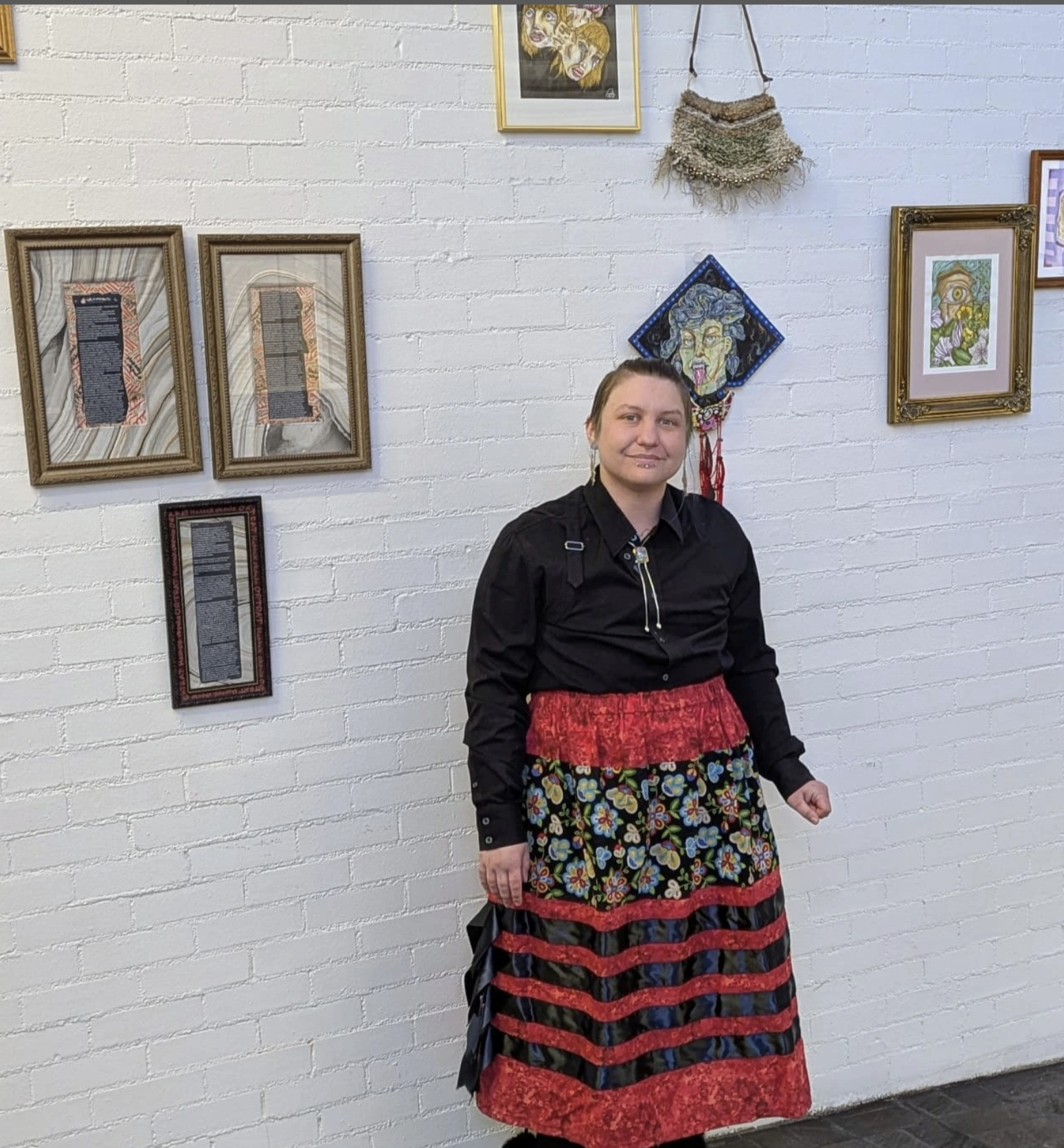
On Jan. 27, the Martin Art Gallery welcomed artist Rain Black for a live Artist Talk regarding their exhibition, “Kommichi: A Continuous Ache.” Displayed on the Outer Wall Gallery, Black’s pieces employ vibrant watercolor, beading and twining in order to explore their identity as a mixed Indigenous two-spirit autistic artist and survivor of domestic violence. As they shared, the term “two-spirit” was created to encompass a spectrum of gender identities across Native groups. Two-spirit individuals may embody a diverse range of genders and sexualities, and the term is used in direct resistance to the enforcement of the colonial gender binary.
Starting the talk, Black elaborated on their identity and how it impacts their artwork. Black is an unenrolled Indigenous person with Choctaw and Cherokee ancestry. While they were not raised within the Indigenous community, they connected with their indigeneity through cultural revitalization efforts. In embracing their culture, they’ve found a new sense of belonging.
As a white-passing person, Black also reflected on the complexities of Indigenous ancestry. Black’s ancestry has occasionally been brought into question, as Choctaw and Cherokee are the most common groups that “pretendians,” or those who falsely claim Indigenous ancestry, will reference. For them, an important aspect of engaging with their community is “being honest about where I’m coming from,” and stating “I’m a descendant.” As Black noted, “Engaging in [cultural revitalization] is in direct opposition to colonization.” They furthered, “I think it’s always worth it to own your identity.”
One important way Black has contact with their ancestry is through language. “Kommichi,” the title of their exhibition, is the Chahta Anumpa, or Choctaw Language, word for “to ache (of a body part), be painful.” They’ve also received ancestral markings, specifically tattoos, in order to connect with their culture.
The first medium Black presented while explaining their artistic process was watercolor. They expressed how most of these works are figurative and “often embody what I’m feeling.” One piece, “Exorcism of a Pathetic Man” depicts Black’s head impaled by a sword. This piece was created as a means of processing their past as a child bride in Mississippi– married at 17 to a man seven years their senior. “I had been cheated on and was being abused,” Black reflected, “I wanted to let part of myself die.” To them, this painting represents “letting go of that old self.”
Continuing that exploration of survival, Black presented a series of text-based collages titled, “Hattak okpulo 1, 2, 3.” These pieces included a message from Black’s abuser asking them to return, which Black surrounded with the term “Hattak okpulo” on birch bark. Written in the Cherokee language’s habitual tense, the term signifies “bad man” in a sense that is perpetual. Black noted, “There is no moving it or changing it, it is fact.” Thus, Black made a statement against the manipulation of their abuser. However, other galleries have not always been receptive to “Hattak okpulo.” Black noted it was once censored, sharing “How can I be harassing someone with their own words… or misrepresenting them?” That emphasized, “I’m so happy that they [Hattak okpulo 1, 2, 3] found a place here.”
Black then discussed their piece “Offochi,” a watercolor that depicts them crying onto a group of plants that are both historically used in magic and poisonous. In this piece, Black again explored the pain they experience, but also their resulting growth.
“I think it’s always worth it to own your identity.” – Rain Black
Black next introduced “Sint-Holo,” a piece incorporating beadwork, leatherwork and watercolor, as the centerpiece of their exhibit. Inspired by the horned serpent of the same name from Choctaw and Cherokee mythology, Indigenous funerary head sculptures and Caravaggio’s medusa. The piece included a beaded gorget (neck armor) resembling a medical model of the neck. This piece was stuffed with herbs like sage, cedar and tobacco, which were typically used for offerings, exchanges or “thank you’s.” Black also dyed the moose leather that made the back of the beaded gorget and blood droplets in patterns resembling ancestral markings to further explore their identity as a mixed person.
The final piece Black touched upon was “Nukua hlopullichi,” a venture into twining that explored anger. In creating this piece, Black foraged for plant materials in order to create cordage out of their fibers. Black shared how both beadwork and twining are often associated with Indigenous arts; However, many cordage textiles have not survived because plant matter degrades over time. Black utilized plants like Mulberry, nettle, dogbane, yucca and sumac. By alternating from cordage with rough fibers to soft fibers, Black reflected on how anger is “useful, but you can’t let it control you.”
Much of Black’s work contains aspects of horror, which they explained causes some viewers to react negatively. A member of the audience asked Black, “Are you confronted with other people’s discomfort a lot?” In response, Black explained that many people, often those coming from positions of power, make remarks like “It’s spooky.” That being said, those with similar experiences to Black often benefit from seeing their work. Black then shared encouragement, stating, “You’ll reach the audience you’re trying to reach eventually.”
As the Outer Wall Gallery is frequented by much of the Muhlenberg population, our campus has effectively become Black’s audience. Reflecting on the exhibit, Gabi Damens ‘27 remarked, “Black’s work provides such an interesting and unique look at the exploration of one’s identity and finding hope after trauma. The themes and artistic style are thought-provoking and leave a lasting impression.” Ella Zalot ‘27 also added, “The messages of the artist were so emotional yet clearly defined throughout the exhibit.” She also reflected on the emotional intimacy of the display, stating, “The frames used make it seem like they are straight out of a home, showing how personal these pieces are.”
When asked about the experience of sharing their work with members of the Muhlenberg community, Black expressed, “I really appreciate everybody’s supportiveness.” For those looking to engage with Black’s art, “Kommichi: A Continuous Ache” will be on display until Aug. 8 and they can be found on Instagram @petri.chor.art. For further information about Indigenous art, Black recommends “Hero, Hawk, and Open Hand: American Indian Art of the Ancient Midwest and South” by Richard Townsend and “Sun Circles and Human Hands: The Southeastern Indians Art and Industries” by Fundabuk et. al.

Emma Northrop '27 is a History, English Literature and International Studies major at Muhlenberg. She loves writing for the Weekly, and is immensely excited to be a managing editor. When not at the Weekly, she loves reading her favorite fantasy novels, drinking lavender vanilla iced lattes, and scrapbooking.