



















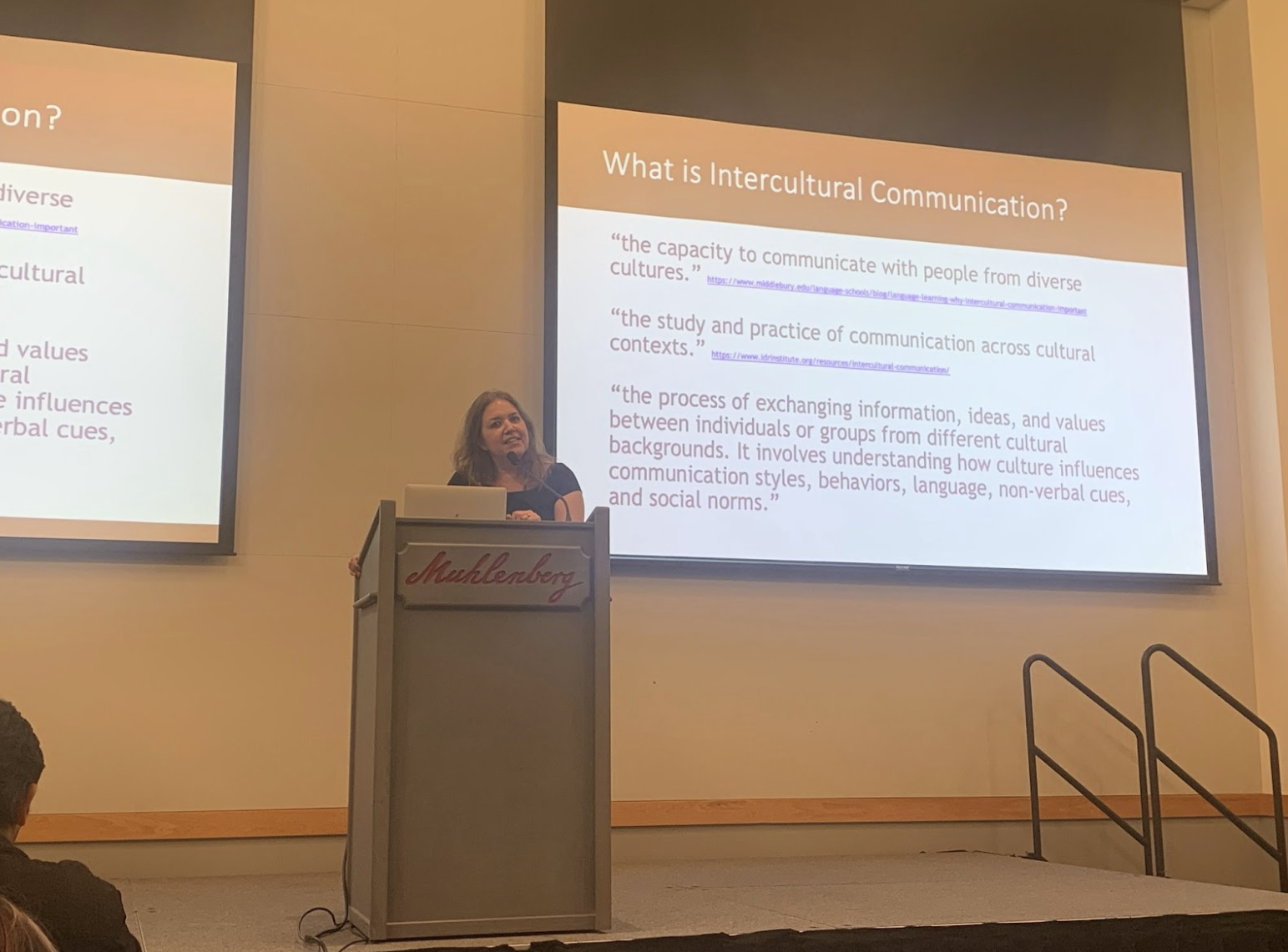
On Nov. 7, The Department of Language, Literatures and Cultures invited Catherine DiFelice Box, Ph.D. ‘97 back to campus as a guest speaker. Box is now a lecturer in educational practice at the University of Pennsylvania and is the co-founder of MultilingualWorks, LLC, an organization that works with schools to develop inclusive, multilingual learning communities. She worked closely with the department during her time at Muhlenberg, given that she graduated with an A.B. in English and French. She marveled about how she was now giving her own lecture at her alma mater to which many of her former professors were attending. In her lecture, entitled “Reflections on Intercultural Communication in an English-Dominant, AI Emergent World,” Box shared how her experiences teaching English as a Medium of Instruction (EMI) to professors at the University of Chile increased her own understanding of intercultural communication.
Box began by displaying multiple definitions of intercultural communication on the projector, one of them being “the capacity to communicate with people from diverse cultures.” She explained how scholars have attempted to characterize “culture” with metaphors conveying its multilayered structure, such as an iceberg or a tree. Accompanied by pictures of icebergs melted upside down and an uprooted tree, Box questioned whether these models provide a satisfactory definition of what intercultural communication is by stating “What if none of these things work because that’s just not how communication works… maybe it’s not something we can draw a model of so easily because we’re human beings in ever-emerging contexts with different goals and coming into contact with language in different ways all the time.”
Box expressed her belief that intercultural communication should be defined by moment-to-moment interactions between people rather than fixed models. She began by asking, “what does it mean to have intercultural communicative skills in one particular time, in one particular place, with different people?” One of Box’s endeavors as a professional in linguistics has been working with people and organizations to help offer English language programming for courses in various subjects for schools in global continents– an initiative that the US Department of State funds. Last summer, Box was part of these initiatives as she was hired to train faculty in Antofagasta, Chile on how to offer courses in medicine, engineering and physics in English. She explained, “The professors are not English teachers. They speak English, but they don’t know how to actually teach English, and so because their students are not first-language speakers of English, they need to feel equipped with ‘well, my student can read this, but how can I help them make sense of whatever text I’m giving them? How can I help them understand my lectures, which are in English?’” This is where Box came in.
Box shared her initial surprise and nerves at the fact that she was assigned a country in South America given that she did not speak Spanish and her studies were centered in French. She eventually found out that this was a central reason as to why she was assigned to Chile as her students would be forced to speak English. However, Box’s experiences abroad increased her understanding of intercultural communication in that she learned that this statement was not fully true. This was because she found that even though she knew no Spanish, she was able to draw upon other contexts to derive meaning. Box had several anecdotes prepared that exemplified her point, ranging from being able to understand her students based on their shared contexts and their gestures, to understanding labels in a grocery store and knowing that a woman was asking her to clarify if an egg carton was expired or not by simply pointing at the expiration date, squinting and asking “junio?” She explained how this experience was transformative for her in that it changed how she defined intercultural communication and its capabilities. She said, “This is actually intercultural communication: looking at something you don’t quite understand and going through the process of digging into it and saying ‘what could this mean?’”
“Just because you are a native speaker in a language doesn’t mean you understand everything about that language.” – Ava Lundy ’27
Box expanded upon the transformative nature of this experience in challenging the common belief that putting a teacher who only speaks English in a classroom with students who do not speak English as their first language would force them to speak English all the time. One part of this was her realization that “language does not exist in siloes,” which she explained can be identified everywhere, from her daughter being able to start a sentence in English and end in French at her school in Montreal, to the ability of people to change the way they speak based on who they are talking to. When Box was assigned to teach in Chile, it was assumed that she would be an authority figure given her ability to understand English as a first-language speaker, but she soon found that this was not the case: “[my collaborators] would say things to me like, ‘Oh that comment I made in your class the other day about how I adapt this to a large class, I wasn’t actually asking you. I was asking that because my boss was in the class with you…and I wanted him to hear that I’m tired of these large classes.’ Apparently, the boss got it, the professor got it, everybody else that was in the training got it. Guess who had no idea? The first language English speaker,” Box said, raising her hand.
With this anecdote, Box established how knowing English does not necessarily put native English speakers at an advantage and encouraged the audience to challenge these notions. This was the most meaningful point made in the lecture for Ava Lundy ‘27, who reflected on what she learned with the statement, “Just because you are a native speaker in a language doesn’t mean you understand everything about that language. Other people who are just learning the language could have different phrases that may mean something different that you may not have thought of before.” Box left her audience with a new understanding of intercultural communication as moment-by-moment interactive endeavors, as well as a questioning of the idea that “native” speakers know all there is to know about their first language.

Samantha Tempkin '25 is a theatre and media & communication double major. During her time with The Weekly, she served as an assistant editor for News and a lead editor for Arts & Culture.