



















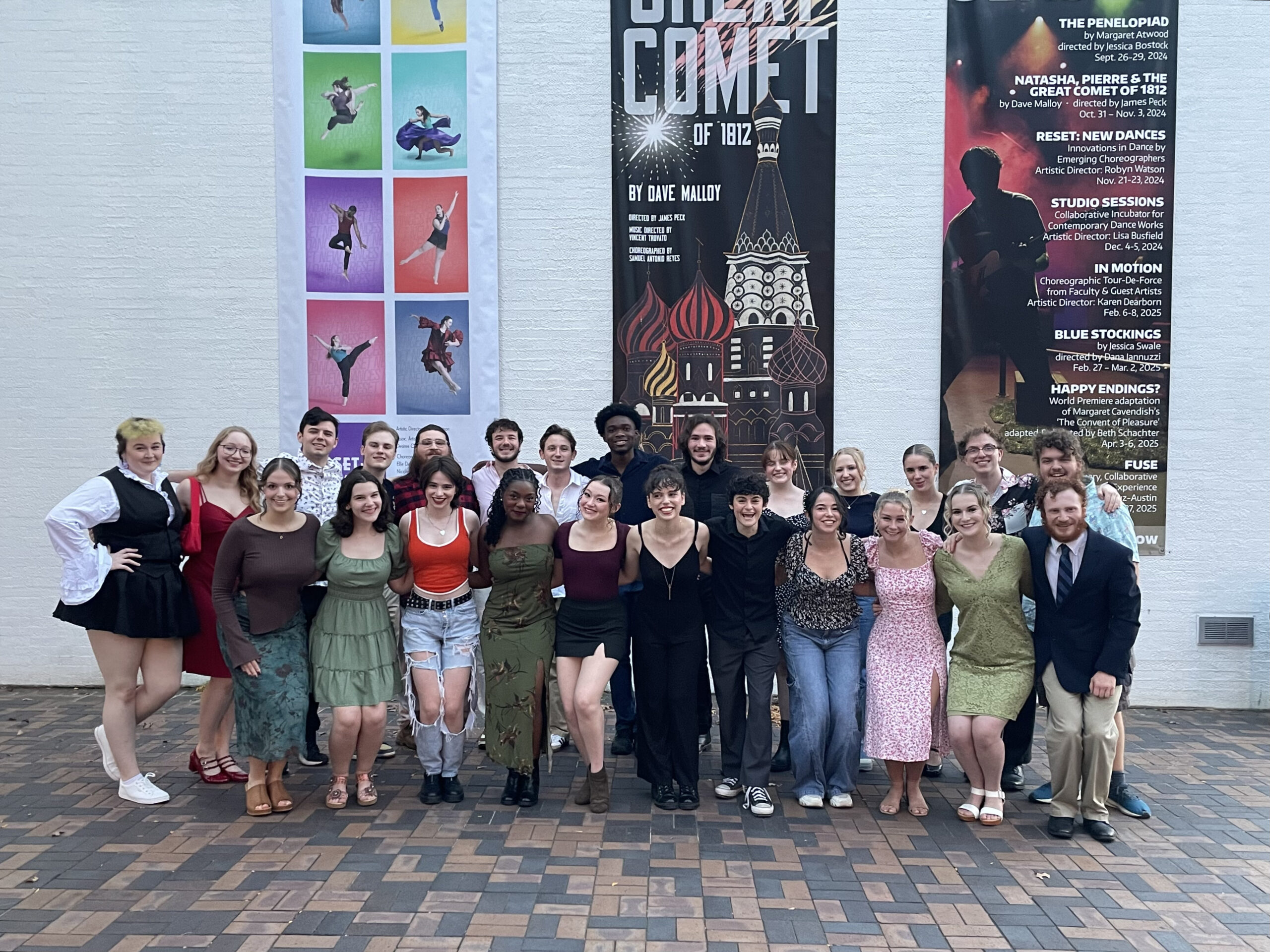
“Natasha, Pierre & The Great Comet of 1812” became a popular choice for the theatrical programming of colleges and universities across the country ever since it was licensed by Concord Theatricals in February of 2020. With the advent of these productions, creative teams have been tasked with bringing something new to the material all while honoring the original artistic integrity of the piece. Muhlenberg’s recent production of the musical proved to be a successful balance of these two ideals as the Lehigh Valley Press called it “one of the best theater productions of 2024 in the Lehigh Valley.”
“Natasha, Pierre & The Great Comet of 1812” (“Great Comet”), written by Dave Malloy, is based on a 70-page portion of Leo Tolstoy’s “War and Peace” that follows the story of the young countess Natasha (Maddie Ciliento ‘25) as she is swept off of her feet by the conniving Anatole (Luke McIntyre ‘25) while awaiting her fiancé to return home from the Napoleonic Wars. Her story ties into that of Pierre (Sam Roter ‘25), Anatole’s brother-in-law, as the mental toil he experiences while questioning his existence as an older man in Russian society becomes the impetus for him to save both Natasha and himself. Given the source material of the musical, audiences may have been surprised to hear the music of the show given its classification as a pop opera that mixes electronic and classical genres to produce both a modern and historical sound. Elizabeth Vichness ‘25, who plays the disloyal wife of Pierre and sister of Anatole, says “I love the music of this show so much. It was so much fun to get to listen to it every day…I think that’s probably my favorite part. Getting to sing and hear that music every day.”
Director and Professor of Theatre James Peck, Ph.D., suggests that the link the music establishes between the past and the present is very purposeful and contributed to his decision to bring the play to Muhlenberg audiences. In addition to producing “Great Comet” as an opportunity for the community to see or participate in what he identifies as “among the most beautiful and challenging musicals of the last ten years,” Peck also acknowledges how its messages regarding the privileges of the upper class could resonate with audiences both in encouraging them to reflect upon how they contribute to systems of oppression and how they are affected by them. This is only made clearer by a dramaturgical entry in the playbill by Dramaturg Rowan Joyce ‘24 that details how social hierarchy structures in late 19th-century Russian society allowed aristocrats to live lavish lives at the expense of the working class – after all, the audience is periodically reminded amidst viewing the luxuriousness of the Russian aristocracy that there is a war going on.
On this, Peck states, “I think that the play is at one in the same time, a play about very privileged people who blind themselves to a world of pain and suffering, and the play is critical of that. And, at the same time, says that those same people make consequential, vitally important life decisions that affect their fates, the fate of the people around them, the state of their soul in the world…I think the play believes that both of those things can be true at the same time, and I think that’s beautiful and applicable to the campus and the life that I live and what happens here.”
This is a principle that was particularly useful to Josephine Glass ‘27 as she developed both her own character of Sonya (Natasha’s cousin) as well as her character’s relationships. She says, “Sonya is a very interesting character due the fact that her livelihood depends on her relationship with Natasha and whether or not Natasha’s engagement is successful. I also think Sonya is wholeheartedly and undoubtedly devoted to Natasha, but also struggles with the fact that she does not hold the same privileges as her–Natasha is oblivious to this, which makes her a lot more grounded and a character that I relate to. I really enjoyed bringing this character to life, because I do see myself and Sonya in some ways, and it was fun to play a character that was so deeply devoted and loving, even though she does not necessarily have the happiest ending.”
As a result of his focus on the social hierarchy of the play and its effects on relationships, Peck went into his direction with two guiding principles. One of them was portraying the ensemble as an antagonistic force that delights in the suffering of the central characters just as much as the principals turn their backs on the suffering of the working class. The other was establishing a link between the cosmos and redemption, suggesting that the comet of 1812 itself is a symbol for the benevolence and forgiveness imparted by the universe. Assistant Directors Anna Item ‘25 and Emma McKinley ‘25 contributed to this vision by acting as an extra set of eyes who not only could take directorial notes while Peck kept his focus on the stage, but could also give additional insights regarding how certain choices added to the meaning of the piece. McKinley offered examples such as her reaction upon viewing ensemble members Dan Harel ‘26 and Shay Seymour ‘26 drinking tea while characters Anatole and Dolokhov (Dami Shote ‘28) discussed plans to kidnap Natasha for elopement during the song “Preparations.” After communicating to Peck her belief that this really helped drive their identification of the ensemble as an antagonistic force, it increased the understanding of the scene in terms of what it was doing within the production for the cast members involved. McKinley says, “For the most part, we were really big on insight and being sort of a sounding board for [Peck]…we would say like ‘oh, this is what’s being reflected back to me,’ and then, depending on what the insight was, sometimes he would share that with the cast to direct their acting choices and give them an idea for what they were going for.”
“I was floored by all the performances in the show.” – Alyssa Kaplan ’25
Item expanded upon this idea by emphasizing the meaning she hoped audiences took from specific moments in the production. Regarding the final image of the production, she says “As the comet blazes brighter and brighter at the end of the final number, “The Great Comet of 1812”, the whole ensemble turns to directly face the audience and outstretches their hands ever so slightly to invite the audience to have the same experience of checking in with their souls and finding forgiveness and the possibility of a better life moving forward.” Item continues to explain how the message this closing image sends regarding redemption and the possibility that everything will be ok is personally meaningful to her with the statement, “I hope that the audience saw the mental health struggles of the two titular characters and felt empathy and a sense of the possibility for a new life. It is never too late to change.”
Dance Captain Nikolas Segura ‘28, who was responsible for ensuring that the choreography by Samuel Antonio-Reyes, adjunct professor of hip-hop, was carried out as intended, explains the role that small details in the choreography played in portraying the ensemble as an antagonistic force, which is why it was so important for him to ensure that the company was maintaining those details: “[Reyes] did not only a great job of telling the story through the dance, but also really manipulating our bodies to showcase that we’re confident, judgy and we’re constantly watching…in the beginning of ‘Letters,’ we sit in our hip…and the thing we’re doing with our hands is like we’re grabbing. We’re literally grabbing the story and making it our own, and through that, I feel like it just gives such an antagonist feeling.”
“Great Comet” was received positively by Muhlenberg community members such as Alyssa Kaplan ‘25, who came fresh out of opening night on Oct. 31 with the statement, “I was floored by all the performances in the show. Just the way the lighting and the dance and the music all came together was so beautiful and captivating and kept me engaged the whole time.” As Kaplan notes, design elements were an integral part of this production, particularly in demonstrating the lavish lifestyles and privileges of the principal characters that allow them to turn a blind eye to the suffering of the lower class . Assistant Costume Designer Chrissy Cirone ‘26 expands upon this idea by providing insight into details of the costuming: “I saw that the costumes for Sonya and the opera costume for Heléne needed a bit more flash on stage and to catch the light more so I decided to add on some rhinestone that were heat pressed on using a bedazzler to make the white and red dresses with the matching color rhinestones catch more light when the actor with the bedazzled dresses were caught by the light on stage!” Muhlenberg’s production of “Natasha, Pierre & The Great Comet of 1812” proved to be a monumental success in its ability to capture the integral themes of the time period related to social hierarchy and mental health all while communicating how these themes still apply today.

Samantha Tempkin '25 is a theatre and media & communication double major. During her time with The Weekly, she served as an assistant editor for News and a lead editor for Arts & Culture.