



















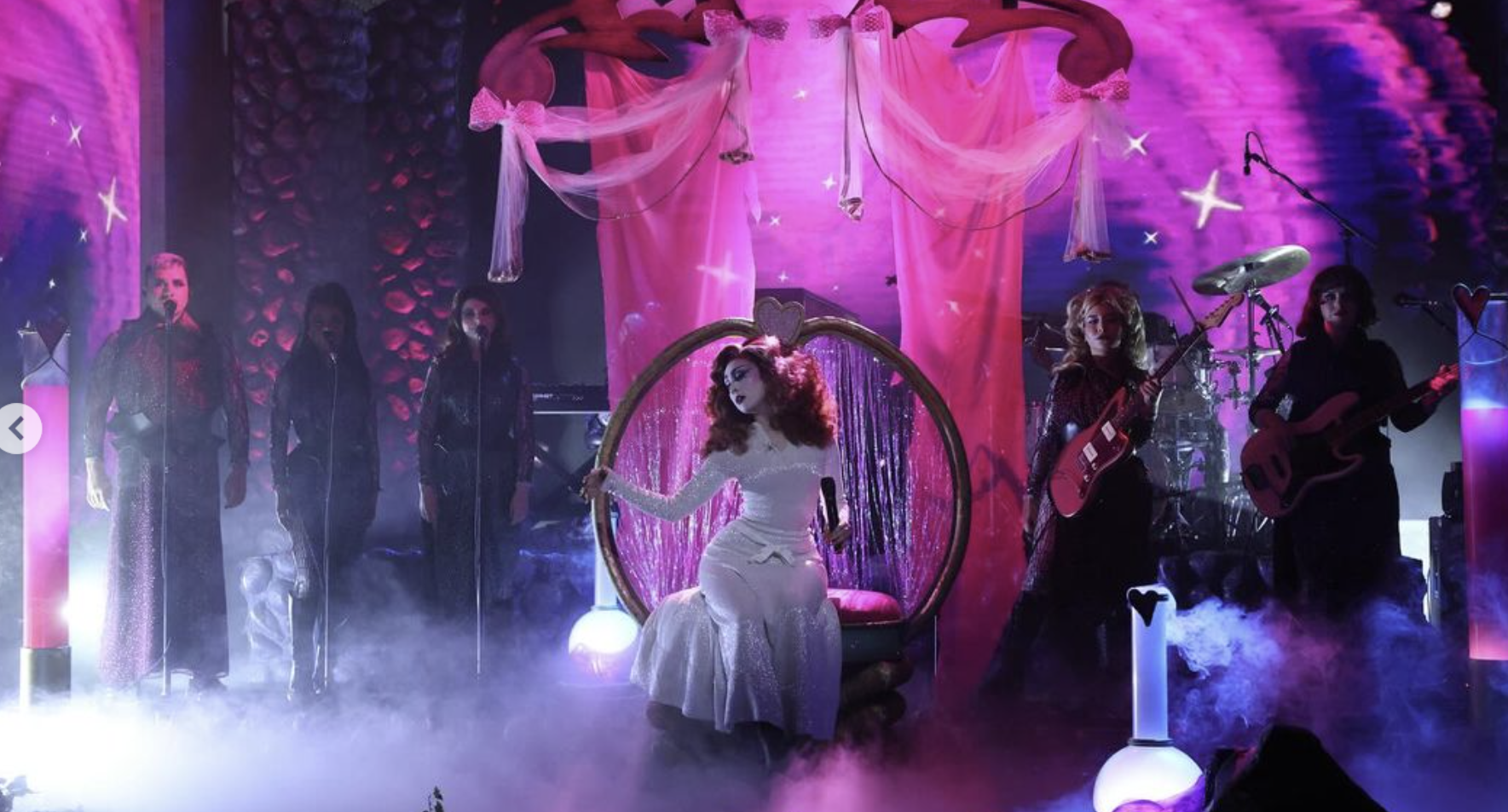
I don’t have to explain, in Muhlenberg’s student paper, who Chappell Roan is. This is why it was such a big deal when she refused to endorse Kamala Harris in the upcoming presidential election. Her brand of queer pop superstardom very clearly lends itself to a block of young, left-wing, would-be Democrat voters who feel like the party has left them behind.
The Sanders campaigns of 2016 and 2020 were the most exciting electoral political action I’ve seen in my lifetime. This year’s Democratic primaries, which proceeded as more of a formality than anything else, did not have a candidate who represented that type of political energy within the party. This is already a problem, as the primary process is hypothetically a vital part of keeping our republic democratic. However, there was a movement to vote “uncommitted” in the Democratic primary, which called for a ceasefire in Gaza and for our government to institute an arms embargo against the Israeli Government. This earned over 700,000 votes and was granted 30 delegates to the Democratic National Convention.
It’s worth noting, from a politically strategic standpoint, that the movement was started in Michigan, a high-profile swing state that Democrats lost in 2016, but won in 2020, which has the highest number and percentage of Arab Americans in the Union. This bloc of delegates requested that a Palestinian-American speaker be allowed to speak at the convention, even supplying a list of Democratic elected officials who would be willing to speak. This request was denied, prompting delegates to stage a sit-in outside of the convention, where they were waiting for a call from party leadership that their request had been granted. The call never came. Like Roan, the uncommitted movement has spoken out against Donald Trump’s campaign, but declined to endorse Harris’. A common refrain heard when discussing the Israel-Palestine conflict is that “it’s complicated,” as multinational conflicts over disputed territory often are. However, there is evident flaw in declaring that something is complicated while consistently advocating for American policy of seemingly unconditional military support of Israel. Within the past two decades, there has been a consolidation of power by Israel’s increasingly extreme right wing, most notably associated with Prime Minister Benjamin Netanyahu, a direct ideological descendant of Ze’ev Jabotinsky.
But this article is about American politics, not Israeli. While the war in Gaza (and now Lebanon) threatens to be to Harris’ campaign what the Vietnam War was to Hubert Humphrey’s in 1968, it is not the only issue that I find Harris to fall short on. The Democratic Party’s rightward shift is clear on issues like the border, the key issue that sparked the MAGA movement. A focal point of the Democratic National Convention (DNC) was presenting the party as invested in securing the Mexican border, a speaker slot being given to a Texas sheriff. Harris recently bragged that Democratic administrations have done more to build the wall– a motif associated with Trump’s original campaign– than Trump has. In 2016, Democrats were by and large horrified by Trump’s fear-mongering about the border. Now they’ve embraced it and in some cases are outflanking him on it. And there’s fracking. In 2019, Harris supported banning fracking. Now she says it’s an important part of our energy sector. This is a clear concession to big oil, and a real middle finger to voters concerned about climate change, an issue that energizes many young left-wing voters.
When asked this week about Trans people’s right to access gender-affirming care, Kamala’s answer emphasized the importance that people “follow the law.” Are voters like Chappel Roan, who said that Trans rights are her number one issue in politics right now, supposed to see that answer and not ask for any better? And it’s clear what the Democrat’s strategy is. A big part of Biden’s coalition in 2020 was disaffected Republicans, who feel that Donald Trump’s version of the Grand Old Party does not represent their values. And I understand the strategy of a “big tent” of who a campaign appeals to, but what are young left-wing voters supposed to think of a campaign doing more to make room for Dick Cheney than for us? Are we supposed to act like we’re happy to vote for this campaign? Should Chappell Roan be mocked by high-profile liberals like Olivia Julianna (the 21-year-old DNC speaker from Texas) for having concerns?
I’m a son of the Green movement, but I don’t believe that the current version of the American Green Party is really worth voting for. Third parties that emphasize down-ballot local campaigns, like the Working Families Party, might be worth consideration, but it’s become clear that the modern Green Party’s only mission is to boost Jill Stein’s level of fame. It’s important to emphasize though that every vote that goes to Jill Stein is not a vote that Stein “stole” from Harris, but rather a left-wing voter that the supposed left-wing party failed to reach. In this sense, the Stein campaign serves less as a gauge of what the Greens do well, and more as a gauge of what the Democrats do not.
And of course, I have to address the elephant in every room in America since 2016: Donald Trump’s version of conservatism. The fact that it’s worth debating if it’s in line with Hitler’s ideologies really does kind of say it all. And no, the Hitler comparison does not come from me. It comes from his own former chief of staff John Kelly, and current running mate JD Vance. There would not be a million results under news when I search “Trump Hitler” if the Republican candidate wasn’t a very obvious danger to all of our safety.
So yes, I’ll be casting my vote for Harris/Walz. But I’m not interested in pretending to be happy about it. And I’m sick and tired of acting like we should feel bad for wanting better.
