


















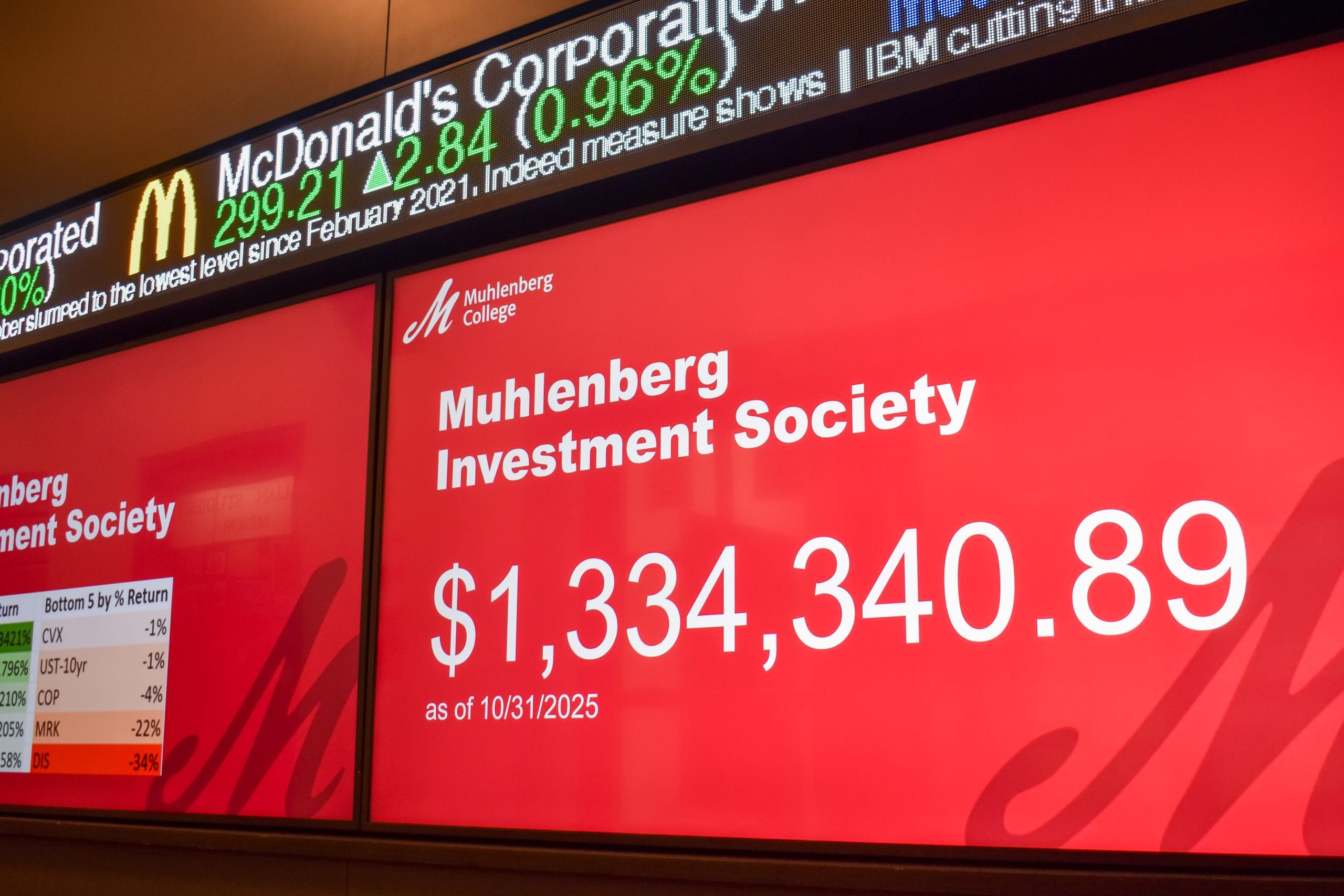
If any words could describe today’s market, they would be “volatile,” with stocks fluctuating in response to a social media post from the president and a rapidly changing economy driven by artificial intelligence. This means that there is a significant amount of risk for investors, but also numerous opportunities. This makes the role of the Muhlenberg Investment Society in teaching young investors to navigate the market both essential and challenging. Fortunately, the club offers a range of tools that provide its members with a gateway into the complex world of modern business.
The club was founded in 2008. Over time, its holdings have grown significantly, especially in the last few years. As Roger Slane, lecturer of economics & finance and the club’s advisor, said that in 2022 “the club was overseeing just over $800,000 in assets. Today, the portfolio value has grown to over $1.3 million.” In an interview with The Weekly, Gabriel D. Seinfeld ‘27, the club’s president, said that “Diversification among sectors is of top priority to the fund as it lowers risks and makes us better balanced. Currently, we sit heavily in the tech sector, but this has been seen across the market.” Some of their best investments were Nvidia, which grew by over 3,000%, and Palantir, which grew by over 2,000%. Over the past couple of years, the club has implemented several significant changes to its investment strategy. Slane said, “Approximately 75% of the portfolio’s assets were sold and reinvested in new positions.” The club’s profits are part of Muhlenberg’s total endowment; however, they’re held in a separate account and are primarily used by club members to learn about finances. The club’s profits stay in the club account and are only used in further reinvestments.
“Diversification among sectors is of top priority to the fund as it lowers risks and makes us better balanced. Currently we sit heavy in the tech sector but this has been seen across the market.” – Gabriel D. Seinfeld ‘27
Another one of the club’s stated goals is to introduce people to the world of investment. “Any student can join the club with no background. And we want every student to join, but especially [those studying] accounting, business, economics and finance,” Seinfeld said. The club also provides new members with a basic understanding of financial knowledge. The club is divided into multiple groups by economic sector, including technology, healthcare and energy. This allows students to focus on their specific interests. However, students cannot choose an investment independently without approval from Slane.
I attended a meeting to gain a stronger understanding of how the club operates. It began with Seinfeld presenting how their investment was doing that week. They discussed recent market events, such as Federal Reserve Chairman Jerome Powell’s rate cuts. After that, they examined specific investments, including VISA, semiconductors, Nvidia and Nuclear Energy. This is also a time when students can suggest a stock to invest in. For example, Ryan Tasetano ‘27, the club’s vice president, suggested investing in Coca-Cola as a good long-term investment due to its household name. However, he also mentioned that it could be risky as the introduction of cane sugar was due to pressure from the Department of Health and Human Services, headed by Robert F. Kennedy Jr, could hurt their profits. Then, a debate started over which business is better, Coke or Pepsi.
As Roger Slane, lecturer of economics & finance and the club’s advisor, said that in 2022 “the club was overseeing just over $800,000 in assets. Today, the portfolio value has grown to over $1.3 million.”
After the club concluded, I had the opportunity to speak with some of its members, including Hudson Plaskoff ‘28, who heads the club’s Energy, Industrial and Utilities sectors. He said, “I joined the club as a freshman because I wanted to learn more about investment and finance, and it grew into a leadership position in the club.” When asked about what this club has done for him, he responded, “I got better at finding information about the markets, how to analyze companies and networking for internships.” Plaskoff is presently analyzing nuclear energy and natural gas, as well as their future as alternatives to oil.
For students interested in learning how to build a stock portfolio and understanding the current market landscape, the Muhlenberg Investment Society provides an opportunity to achieve these goals. It can provide hands-on experience in the markets, with oversight, and without the risk of losing your own money. Anyone can join, regardless of their future careers or majors.

