



















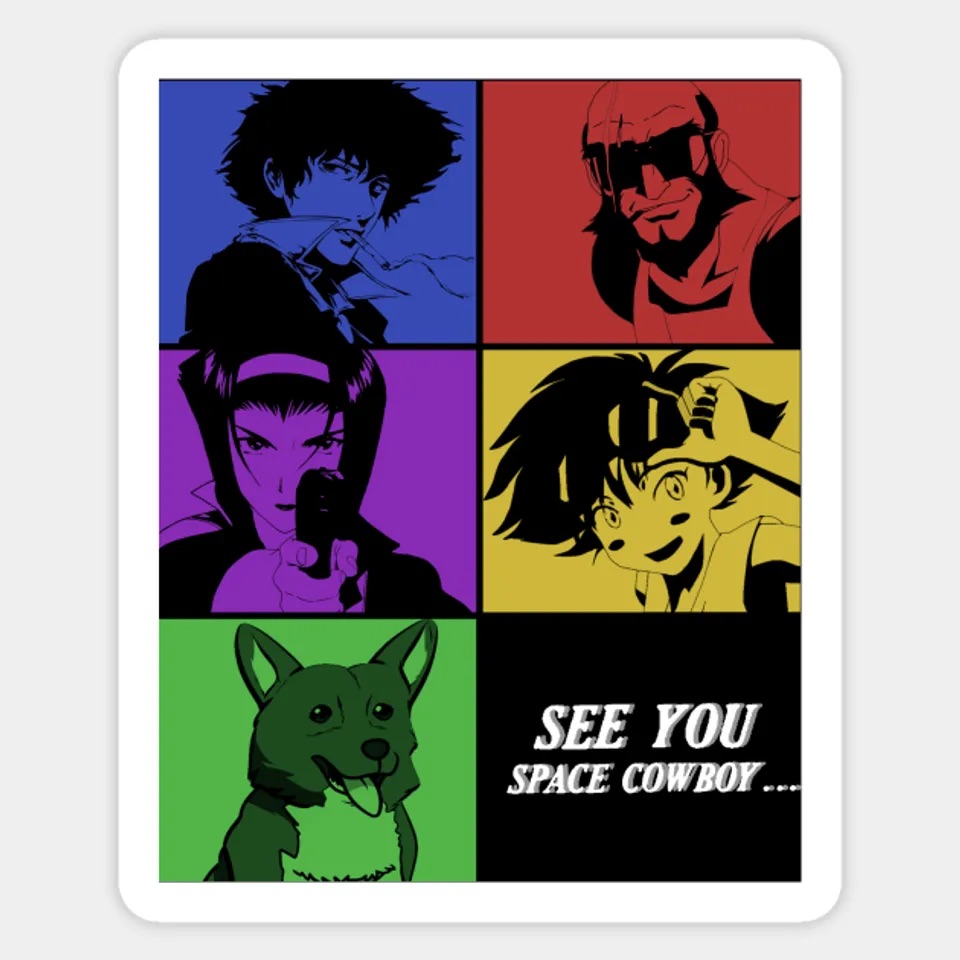
Jazz carried a myriad of ineffable meanings and words unsaid in some of the heaviest scenes of Keiko Nobumoto’s anime “Cowboy Bebop.” I often accompany a song to long weeks of my life. A song I accompany to bright red Beats headphones in the middle of a grocery store, fingertips at the end of a carefree dance, an aim there to be away from the engineering office. An image behind dark eyes: His feet floating away from their stagnant stance on the corporate floor, then vibrating with the erratic control of a drum. Vibrating with the liberty in movement, of traveling the Earth. He felt that death was coming, and I am thrown back to Jet Black’s words: “Men only think about the past right before their death, as if they were searching frantically for proof that they were alive.”
I wonder what moments of His past He thought of. The pursuit of bringing forth value as a poor immigrant? Of success that can be sent back to the motherland to show proof of your living?
How can you measure the weight of the past? What instances proved that you were alive? Mention of the past can be brushed off by characters in “Cowboy Bebop,” but their lived experiences, repressed or not, are a live wire shaping their drive, their ability to shift out of old cycles alongside one another.
You could have been a lot of things if it weren’t for that moment, that incident, that flash of life inside of you or death outside of you that you repress in your memory. You could have been with the love of your life, someone to lose, her blonde hair long, strands swimming away from the crime syndicate, living in solitude, you could have been more than that. You bounce from place to place with no one searching for you. And if there comes a day when they remember you, you face the fact that you could’ve lived differently. Could’ve been a girl steady on the back of her father, stringy limbs light with the power of your intelligence. If that is what you wanted. More than this. But what if this is all that you were meant to be? The past is characterized by a love lost, a love that drives the “Bang,” which leaves you on the floor and by the absence of parenthood, which leaves you with a four-legged friend to live the life of a cowgirl.
There is the aim to be nothing and to gain everything. To fill the emptiness of the past, the lack of memories creates no expectation of who you should be and what you should care about. In the anime series, Faye Valentine’s “aim” is to remember. She is a woman tied to nothing but searching for everything. And maybe remembering will shape who she is supposed to be. Who she is supposed to belong to. I think about her in relation to suppressed memories; you push it all down so you can rise to do it all. The lack of vulnerability that comes with forgetting allows you to completely hone in on skill before generating product. “A girl with no memory’s got nothing to lose.” Is mastering everything all you have left to gain? The method can be that if there is no anchor holding you down to who you once were, the effort to be splendidly versatile will be painless.
There can be an aim to be everything. An aim to measure the worth of your life. Measuring all that you have done to being alive, and that desire can come too late. Being well-rounded is valued by society that wants to see the product of your journey: pages of beautifully crafted words, music sheets, records set, your pain turned into prodigy, not what it took to get there. To end up living, instead of giving up, you must keep producing without allowing the past to tumble over the rising of your limbs.
In “Cowboy Bebop,” the past comes swimming back, no matter the nomadic, free-falling nature of the bebop spaceship, the literal jumps into space, the ever-changing snapshots of setting from desolate deserts to lavish casinos to cold, futuristic cities characterized by skyscrapers bound to be blown up by resisters of capitalism. The past carries a weight that is revealed in beautiful artwork of mystic faces (Julia, Faye’s classmates, Ed’s father) and professions (Jet’s years as a police officer), of years gone by. Yes, the past reroutes these characters, but it has me thinking about this aspiration today to be so much at once and to live towards results. Why do we feel the need to be everything when we can’t even face it all? When we can’t even embrace the parts of ourselves that are still young and haven’t learned? Or the parts that have messed up and remained there in that chaos? What is the aim to be everything if not to forget all that we are? To progress, to love the process and the ebbs and flows that come with indulging in craft is to carry the weight of the past, to confront all the experiences that have made you. The culture that has dressed you and glimmered your ears. You may end up like Spike Speigel, confronting it all to end up lying face down, which can suggest, to some, a certain kind of freedom, or you may work towards living wholly despite the heft of trauma. Of being content with not being it all, but embracing the weight that makes you up.
This spew of thoughts and questions has all been drummed up since reading the final title card of the “Cowboy Bebop” series: “You’re gonna carry that weight.”

Amal ‘28 is a double major in English + Creative Writing and Public Health. She loves to spend her free time writing, reading, and taking walks!