


















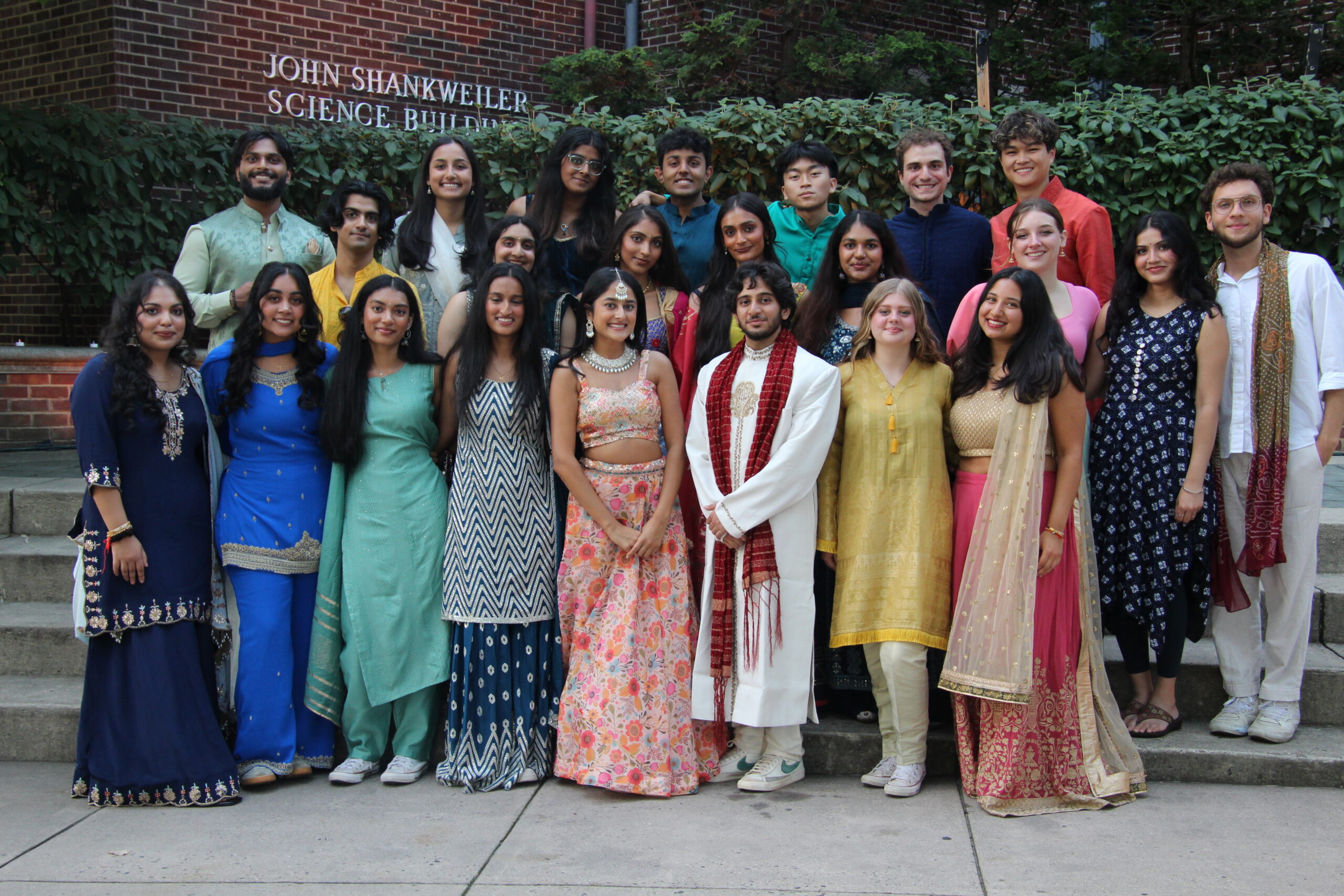
Muhlenberg’s South Asian Student Association (SASA) held a mock Shaadi, a vibrant cultural tradition, on Friday, Sept. 26. During the Mock Shaadi, people get together to throw a mock wedding ceremony in order to represent and enjoy the fun involved in real South Asian weddings. At 6:00 p.m., excited students gathered in Parents Plaza amidst the welcoming breeze, settling beneath the warm string lights.
The hosts, Vish Dsouza ‘26 and Babar Khan ‘26, explained that there are several fun traditions involved in a mock Shaadi. “What is a mock Shaadi?” Khan queried to the crowd. He continued, voicing that not only is it a fun tradition to go through what it’s like to have a wedding, but, “We’re also celebrating music, culture and community.” Some elements of a mock Shaadi that SASA utilized included traditional attire and dances, popular wedding foods, colorful decorations and henna.
The friends and mock families of the bride and groom also play important roles in mock Shaadis. The two sides engage in friendly competitions. The groom’s family was all Muhlenberg students while the bride’s family was made up of DeSales University students. Avani Gupta ‘27, president of SASA, commented, “I think mock weddings are a very popular and fun way to celebrate a culture and I always wanted to do one.”
“After collaborating with Lehigh University for a mock Shaadi hosted by them last spring, it seemed a lot more feasible and it inspired us to host our own,” Sarah, a student from DeSales continued, “We were reaching out to schools all summer when Muhlenberg reached out to us.” Members from both colleges were equally excited to share this tradition with their peers.
Each school performed rehearsed dances, accompanied by a clapping audience. Jimmy Kaba ‘26, a member of SASA performing in the ceremony, noted that in order to prepare for the event, SASA held two practices coordinated by Adrián Padrón-Curet ‘26 and Gupta, that were hours long, and had one 30-minute practice beforehand.
Dsouza and Khan introduced the tradition in which the bride’s side of the family hides the groom’s shoes. The groom has to find them or negotiate with the bride’s side to get them back before the end of the wedding. Muhlenberg’s SASA members sprung into action, searching relentlessly for the groom’s shoes in the span of those few minutes. Vice President of SASA Syan Arora ‘27, who played the part of the groom, exclaimed, “Give me a hint, man!” to a photographer, who noted they weren’t even privy to the hiding spot. Students in the seats watched eagerly, some whispering about where the shoes might be. It was revealed that the shoes were hidden beneath a somewhat nearby traffic cone.
Another tradition is the ceremony in which the bride and groom exchange floral garlands. Gupta explained that they try to throw the garland onto the other person’s neck. After several tries, the bride won this competition. Then, the whole family joined in to see which side could complete the activity first. “DeSales is choking right now,” Khan remarked regarding the heated competition. Ultimately, Muhlenberg’s family won this challenge.
After the event, SASA member Ednah Asiema ‘26 commented, “Since my [first] year, SASA events have been a very big highlight of my experience. SASA has created very strong friendships and community. I feel very welcome in SASA even though I’m not South Asian.”
Eshi Ajvalia, a DeSales student and the bride, said, “I’ve never had such a good experience being in tune with my culture. The population of South Asian students is not that high in this area, so it was so nice to come together like this.”
SASA noted that it is important to remember that South Asia is a “pluralistic community,” meaning many cultures make up the community and no single mock Shaadi could represent the diversity of traditions. According to Khan, this event was one way to show how “colorful, chaotic and joyful weddings can be.”
Photo by Bina Klein ’27.


