


















It’s a Thursday night, and you’re gathered in Memorial Hall with your friends to watch the men’s basketball game. It’s a tight race to victory, and each time Muhlenberg pulls ahead in points, the other team follows quickly behind. They can’t seem to break away. Just as the buzzer is counting down, we score one last three-pointer and the crowd goes wild. We’ve won it. There is a surge of energy that is almost palpable.
Now picture this feeling, but imagine you have money invested in it. Not just any money, but potentially hundreds of dollars on the line. This is the reality for many students as they place bets on some of the top collegiate basketball teams in the country during March Madness. The rush you get waiting to determine your financial prosperity is not one to take lightly. It’s largely unsatisfactory, but all it takes is one small win to get you hooked. Suddenly a $20 buy-in becomes $50 and that quickly becomes $100. It sounds somewhat manageable to some, but it would be easy to find yourself in hundreds or thousands of dollars worth of debt, which can be devastating for college students who don’t have a steady income.
Across the nation, sports betting has become a serious phenomenon. From fantasy football to March Madness, there are many students who have stakes in this game. However, the regulations on college athletes have created a more secretive side to this story. According to the NCAA, their rules ban participation in sports betting and prohibit athletes from providing information to individuals who are involved with any type of sports betting concerning intercollegiate, amateur or professional athletics.
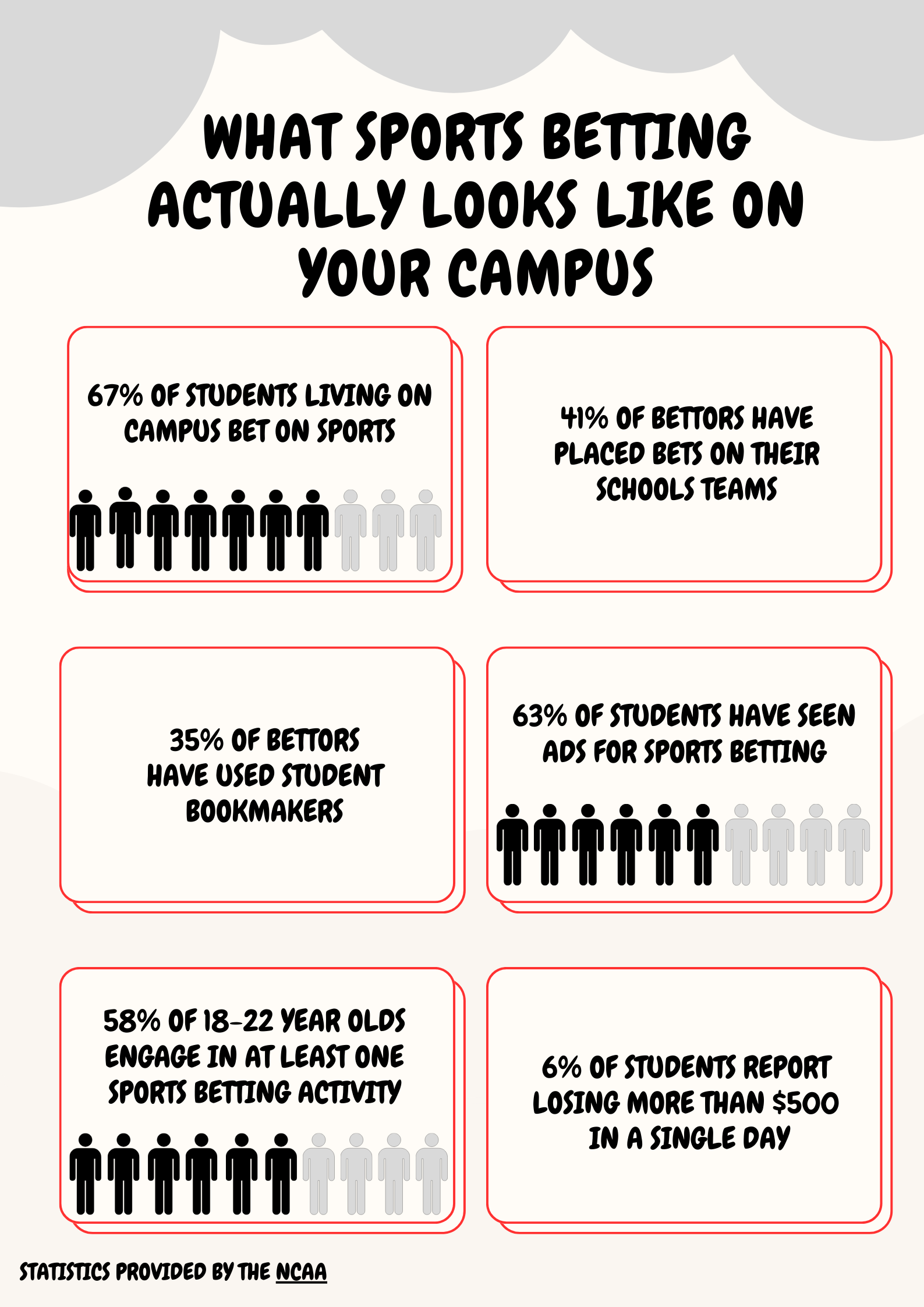
While this rule still stands for collegiate athletes, betting and gambling remain active parts of campus culture. One study from TIME found that 60% of people aged 18-22 participated in sports betting, with 6% of them reporting losing more than $500 in a single day. Another study, from the NCAA that focused primarily on students, found similar results, with 58% participating in sports betting and 4% engaging daily. While these statistics largely focus on all students, there are also studies from the NCAA that focus on athletes specifically. One from 2012 reported that 57% of male student-athletes and 39% of female student-athletes had reported gambling in the last year.
The rule not only exists in order to regulate betting but also to regulate insider information being used to help people win. If athletes are betting on games that they play in, or their friends play, it creates unfair advantages and puts unhealthy amounts of pressure on students to play a certain way based on how people are betting. “It’s illegal in the NCAA for student-athletes to participate in betting because we can have knowledge about how the game will go and make money off of it. It’s comparable to insider trading,” according to a student-athlete on campus, who wished to remain anonymous due to the heavy regulations around this topic.
One study from TIME found that 60% of people aged 18-22 participated in sports betting, with 6% of them reporting losing more than $500 in a single day.
Technology adds an extra layer to this problem. Online services and apps have allowed students to place bets right from their phones, wherever and whenever they want. This also makes it more convenient to connect with your friends and encourage them to participate. “Sports books give you incentives such as free money to bet with. One of the features is sharing codes, so people will share codes with their friends to get free sports bets,” one student-athlete shared.
What is Muhlenberg doing to combat this? While our student-athletes are still held to the same standards as the law states, are we really talking about this enough, or is the school trying to brush it under the rug? The College website has a specific link for gambling help under the “useful links page.” That being said, it really isn’t very thorough or informative. There is a specific link for gambling and athletics that takes you to a mostly empty page, which then takes you to an article from the NCAA. While this is helpful for gathering information, it was rather challenging to find and doesn’t actually provide the students with many resources, it just gives us statistics and a deeper understanding of the presence of gambling.
If this is all that the school is doing to prevent student-athletes from gambling then they may be underestimating how prevalent of an issue this is in our country and on our campus. In regards to their relationship with betting, one student stated, “There’s no negative stigma about it for the teams, people literally talk about it at practice. We even make the occasional joke saying ‘my fantasy team’ *wink-wink*.”
According to a study from Birches Health, the likelihood of college students to gamble problematically is two to three times higher than that of adults. Not only are students more at risk of this type of gambling, it’s specifically being targeted at them. Sports gambling sites have begun targeting most of their advertising to social media platforms, like TikTok, to reach more teenagers and young adults according to AddictionCenter. How can the NCAA reasonably assume that student-athletes are following their restrictions when gambling is so easily accessible to them?
What does this mean for our students? This type of gambling can cause changes in grades, financial distress, debt, sleep deprivation, changes in mood and so much more, especially for young adults. Villanova University states that around 6% of college students engage in problem gambling, so our campus is definitely not safe from this epidemic. This is a conversation we need to be having among our athletes and students. Many college students, particularly student-athletes with already busy and overwhelming schedules, are susceptible to challenges with mental health or stress, and this will only exaggerate that even further.

